293 – Promising Young Woman

Listen on the players above, Apple Podcasts, Google Podcasts, or Spotify.

We’re joined by returning guest Celia, on the phone from Canada, to discuss writer-director Emerald Fennell’s unusual revenge thriller, Promising Young Woman. Following the rape and – implied – suicide of her friend Nina, which goes unpunished, Carey Mulligan’s Cassie drops out of medical school, and now spends her nights feigning drunkenness, allowing men to pick her up and take her home, alarming them with her sobriety as they begin to sexually assault her. When a chance reunion with a former classmate reveals that Nina’s rapist is engaged, Cassie embarks upon a campaign of vengeance against those she considers responsible for and involved in committing and allowing her friend’s rape and its cover-up.

Celia loves it, finding that it invokes and brings to life many subtle and important observations about life for women in the patriarchy, enjoying the various forms Cassie’s revenge takes – particularly the “exercises in forced empathy”, in her words – and feeling a call to arms; José decidedly doesn’t, decrying those observations and revenges as cinematically unrealised in what is merely a filmed essay, albeit one that admirably exhibits a style, an aesthetic and a point of view. Mike bravely sits in the middle, pretending to be superior to the other two by virtue of not exhibiting an extreme response to the film. The discussion is varied and passionate – and full of spoilers. Love it or hate it, Promising Young Woman is a thought-provoking, vital film, and well worth watching.

With José Arroyo of First Impressions and Michael Glass of Writing About Film.

292 – Affair in Trinidad

Listen on the players above, Apple Podcasts, Google Podcasts, or Spotify.

Rita Hayworth and Glenn Ford star in Gild– sorry, Affair in Trinidad, Hayworth’s first film upon her return to Hollywood after four years away, and a blatant rip-off of a certain classic film noir from 1946. (There’s also a chunk of Notorious thrown in for good measure.) Expensively cobbled together at Columbia boss Harry Cohn’s instruction, its production was rushed, with its script barely presentable and Vincent Sherman’s direction lazy, but audiences weren’t put off – it made $7m domestically, blockbuster box office in 1952.

Now featured as part of Columbia Noir #2, a box-set from the same series that includes The Garment Jungle, we take the opportunity to see what Affair in Trinidad has to offer – for José, the answer is, “not much, besides Rita Hayworth, gorgeous gowns and rich cinematography” – and discuss more besides, including Hayworth’s name and image, and how and why they were changed. Affair in Trinidad is far from a good film, but one of historical interest, and certainly worth seeing for any fan of Rita Hayworth.

With José Arroyo of First Impressions and Michael Glass of Writing About Film.

291 – Sound of Metal

Listen on the players above, Apple Podcasts, Google Podcasts, or Spotify.

A film that offers a beautiful evocation of community, as Riz Ahmed’s drummer suddenly loses most of his hearing and joins a retreat for the deaf, Sound of Metal also feels regrettably, and unforgivably, dishonest in some of the ways it engineers its story. In this respect, we disagree over one of the film’s key scenes, but agree about what it goes on to depict in the final act. Despite the severe problems we have with the film, it has pleasures to offer, including an outstanding central performance from Ahmed, whose wide-eyed, puppy-dog expressions transparently convey fear, anger, worry and determination, sometimes all at once. For Ahmed alone, it’s worth seeing Sound of Metal.

With José Arroyo of First Impressions and Michael Glass of Writing About Film.

290 – Godzilla vs. Kong

Listen on the players above, Apple Podcasts, Google Podcasts, or Spotify.

The fourth entry in Legendary’s MonsterVerse, the first crossover in the series, sees a journey to the center of the Earth and Hong Kong made the playground of its titular colossi. In this cinematic universe seeking to challenge Marvel et al., Mike finds visual splendour and an ambition to reach for something a little more meaningful than your usual blockbusters. Indeed, the character of Godzilla, in particular, is well-known to derive from Japan’s horrific experience as history’s first and only target of nuclear warfare, and Mike argues that the MonsterVerse seeks to continue to use its creatures as giant metaphors that punch and breathe fire, unleashed by humanity’s insatiable consumption and arrogant claim on the natural world. José isn’t that impressed with this reading, but finds things to enjoy, particularly the beautiful imagery – though, he argues, while it demonstrates incredible skill and craft on the part of the artists who created it, art is precisely what it lacks. But luckily, although we butt heads over Godzilla vs. Kong, Birmingham remains intact.

Our podcast on Godzilla: King of the Monsters

Mike’s review of 2014’s Godzilla

José’s review of 2014’s Godzilla

With José Arroyo of First Impressions and Michael Glass of Writing About Film.
289 – The Trial of the Chicago 7

Listen on the players above, Apple Podcasts, Google Podcasts, or Spotify.

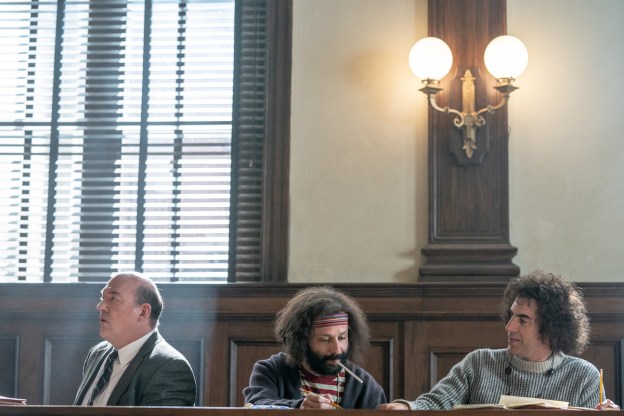
At the Democratic National Convention in Chicago in 1968, riots erupted when thousands of anti-Vietnam War protestors clashed with police. Seeking to crush the energetic counterculture, the US government put on trial a group of eight defendants, some political organisers, some cultural radicals, some with hardly any influence, a pacifist, and a Black Panther, hoping to convict them for conspiracy to incite the riots. Aaron Sorkin’s writing is a good fit for this story, the disparate group of defendants arguing amongst themselves sharply, and many scenes flowing beautifully towards their own internal climaxes; the same cannot be said of his direction, the film lacking much visual flair and instinct for expressive imagery.

We revisit our common theme of British actors playing Americans, José finding more fault with it here than Mike does – we can, at least, agree that Sacha Baron Cohen’s accent is atrocious, his Abbie Hoffman a weak point. Mike expounds upon how much he hates himself for how much he likes Sorkin’s HBO drama The Newsroom, comfort food for the American left, which he sees echoes of here.

We find flaw upon flaw with The Trial of the Chicago 7, but despite every one of them, it’s an immensely watchable film with a terrific ensemble cast and entertaining dialogue. With an awareness of its limitations and economy with the truth, we recommend it.

With José Arroyo of First Impressions and Michael Glass of Writing About Film.

288 – The Father

Listen on the players above, Apple Podcasts, Google Podcasts, or Spotify.

Anthony Hopkins is magnificent as The Father‘s title character, an old man losing his grip on reality to dementia, in debut director Florian Zeller’s adaptation of his own stage play. We discuss the techniques the film uses to situate the audience within the mind of a dementia sufferer, and whether they lose their potency as the film develops. The Father‘s origins on stage are obvious in its sparse setting and focus on dialogue, and we suggest that the raw power of seeing the performances live, an immediacy, is lost here – though the cast, particularly Hopkins and Olivia Colman, are impressive nonetheless. Mike argues that the film somehow lacks enough plot to even fill its 97-minute duration, and would have worked better as a short film – José suggests that it ends up in cliché.

Still, for a while at least, it’s an extraordinarily effective dramatisation of what it might feel like to suffer from dementia, convinced of your own mental acuity while contradicted by everyone and everything around you. The Father doesn’t offer a pleasant experience, but it is a valuable one.

With José Arroyo of First Impressions and Michael Glass of Writing About Film.

287 – Minari

Listen on the players above, Apple Podcasts, Google Podcasts, or Spotify.

A gentle drama about Korean immigrants making a life for themselves in 1980s Arkansas, Minari‘s tone is consistently light, despite some of the upsetting events that occur. Mike argues that it reflects a child’s perspective of life, protected by their parents from the worst of life, or simply not understanding the darkness in what they experience – writer-director Lee Isaac Chung based the film on his own upbringing on a farm in Arkansas. José identifies strongly with the story, commenting on the similarities and differences with his youth as a Spanish immigrant to Canada. Minari is a good-natured film with no room for cynicism, and, for José, a joyous experience to watch.

With José Arroyo of First Impressions and Michael Glass of Writing About Film.

286 – Zack Snyder’s Justice League

Listen on the players above, Apple Podcasts, Google Podcasts, or Spotify.

In 2017, Justice League, DC’s answer to Marvel’s continuing Avengers crossovers, flopped. Director Zack Snyder had left the film several months before release, his role taken over by MCU regular Joss Whedon, and significant changes were made in an attempt to lighten the tone of what had so far been a rather bleak series. Immediately, talk erupted of a director’s cut – the so-called Snyder Cut – that would represent Snyder’s true vision, uncompromised by studio executives’ fears and directives. Initially no more than a meme responding to that film’s quality, it was given oxygen by Zack Snyder’s insistence that it did actually exist, and it now reaches us via online streaming in the age of Covid-19. There’s perhaps no other set of circumstances in which it would have been made real – on top of the original budget, the creation of this director’s cut cost some additional $70m – but what an opportunity to compare and contrast two versions of the same film.

At four hours in length, this is a version of Justice League that would never have seen a theatrical release, but the time it affords its characters to develop is welcome, and a huge improvement over the sketchy treatment some of them received in the original film – particularly Cyborg, played by Ray Fisher, who arguably becomes the central character in the Snyder Cut. We discuss and disagree on the decision to change the original aspect ratio of 1.78:1 to 1.33:1, which José loves but Mike considers a mistake, and look over a few key scenes and shots to explore the differences between Snyder’s and Whedon’s aesthetics.

And we discuss that new ending, additional scenes which help the Snyder Cut conceive of the overall story as epic, mythological fantasy, and more.

It’s a surprise to us both that we enjoyed Zack Snyder’s Justice League as much as we did, but there you have it. The four hours flew by and if this leads to the studio’s renewed interest in completing Snyder’s planned series, we’re up for it.

With José Arroyo of First Impressions and Michael Glass of Writing About Film.

285 – Nomadland

Listen on the players above, Apple Podcasts, Google Podcasts, or Spotify.

Frances McDormand and a cast of non-professional, real-life nomads unite to explore the life of the modern American itinerant in Nomadland. We consider the line between fiction and reality, the non-professionals who appear bringing their real experiences and stories with them, and discuss what drives a person to their way of life. Like director Chloé Zhao’s previous feature, The Rider, Nomadland is a textural, contemplative film, and perhaps one that grows in stature upon reflection – while José loved every moment, Mike was bored by the tempo, but finds much to praise nonetheless. A film worth taking the time to sink into.

With José Arroyo of First Impressions and Michael Glass of Writing About Film.

284 – Judas and the Black Messiah

Listen on the players above, Apple Podcasts, Google Podcasts, or Spotify.

The story of a civil rights activist who deserved a biopic long before now, told from the perspective of the man who killed him. Fred Hampton chaired the Illinois chapter of the Black Panther Party, and using his oratorical skills and powers of persuasion formed the Rainbow Coalition, a political movement in which black, white and Puerto Rican organisations combined and worked together. Hampton was identified as a threat by the FBI and his death is considered an assassination under COINTELPRO, the FBI’s illegal programme of disruption of domestic political organisations. He was killed in December 1969 at the age of 21.

We ask whether it’s a problem that Judas and the Black Messiah frames his story as part of his murderer, William O’Neal’s. For José, the entire story is badly conceived, as Hampton should be the clear focus; for Mike, the problem is in the execution, with O’Neal underdeveloped – but it’s possible that this informant thriller genre structure is what allowed the film to get made in the first place. Mike remarks upon Hampton’s pragmatism in contrast to the narratives around Martin Luther King Jr., murdered only a year before Hampton, which arguably tend to convey idealism for the future as opposed to action in the here and now.

Judas and the Black Messiah is an imperfect but important exploration of an extraordinarily impressive man we should have known more about before now.

With José Arroyo of First Impressions and Michael Glass of Writing About Film.