Category Archives: Podcasts

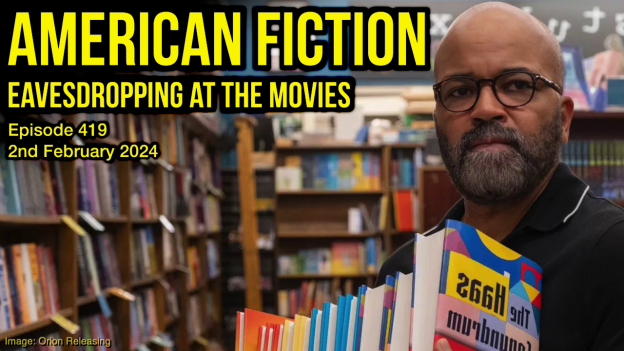
419 – American Fiction

Listen on the players above, Apple Podcasts, Audible, Google Podcasts, or Spotify.

Writer-director Cord Jefferson’s debut feature, American Fiction, combines satire with family dynamics to fairly charming, if visually uninspiring, effect. Jeffrey Wright’s Thelonius is a novelist forced into a leave of absence from his teaching position, whereupon he returns to Boston and reconnects with his family, from whom he’s distant. He’s also furious that his latest manuscript has been rejected for not being black enough, and that what “black enough” means involves every negative stereotype of black people and culture imaginable. But when he sarcastically writes such a novel to shove society’s attitude in its face, it’s taken seriously by the white literary elite, who shower it with praise.

From the trailer, Mike was expecting more focus on the satire, and more energy à la Boots Riley’s Sorry to Bother You. It’s a surprise, then, that American Fiction spends so much time developing the family drama, but not an unpleasant one, and José finds that aspect the film’s most interesting. We consider the idea that the film uses the family story to practice what it preaches, offering a story about black people that doesn’t require them to be black in order to justify its existence – it’s a universal story about distanced siblings, a mother with failing health, and broken marriages. And we discuss the film’s ending, or lack thereof, in which the inescapability of the culture that demands stereotype is emphasised at the expense of a satisfying, earned conclusion to the story we’ve been told.

American Fiction doesn’t create a single artful image, and that ending is disappointing, but the film is also interesting, absorbing, and funny. Worth a look.

With José Arroyo of First Impressions and Michael Glass of Writing About Film.
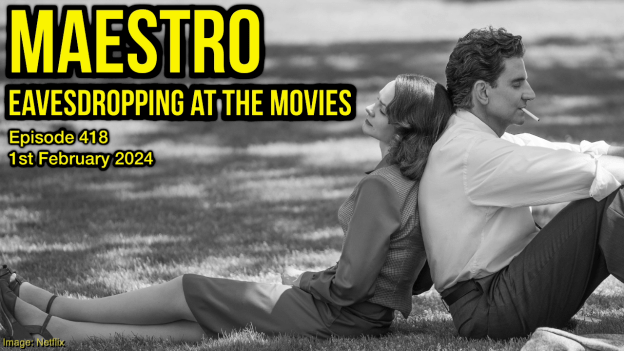
418 – Maestro

Listen on the players above, Apple Podcasts, Audible, Google Podcasts, or Spotify.

We find Maestro, Bradley Cooper’s latest actor-director star vehicle, which dramatises the life of iconic conductor Leonard Bernstein, to be dishonest, illustrative, and superficial Oscar bait. We also find it cinematically ambitious at times, with great production values – not many films of this type are being made with $80 million budgets. A mixed bag.

With José Arroyo of First Impressions and Michael Glass of Writing About Film.
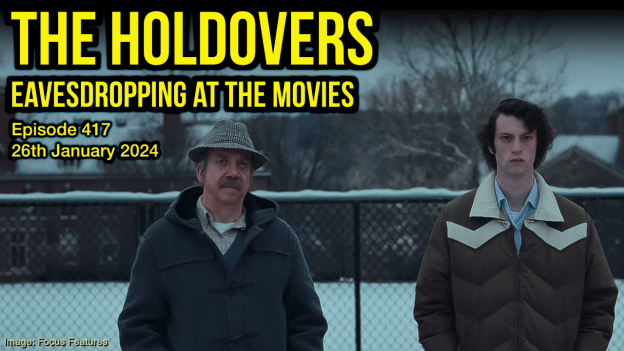
417 – The Holdovers

Listen on the players above, Apple Podcasts, Audible, Google Podcasts, or Spotify.

Alexander Payne evokes the Seventies in form and aesthetic in The Holdovers, a comedy-drama about the students and staff forced to stay at a New England boarding school over Christmas. It exudes charm and, over time, warmth, as the frosty relationship between student and teacher thaws, Payne handles the meandering tone beautifully, and it’s full of good jokes. For José, it doesn’t quite reach the level of the best in its genre; for Mike, it’s a good genre film elevated by some mysterious cinematic alchemy he doesn’t understand.

With José Arroyo of First Impressions and Michael Glass of Writing About Film.

416 – The Zone of Interest

Listen on the players above, Apple Podcasts, Audible, Google Podcasts, or Spotify.

The Zone of Interest is a title that accurately reflects the film it adorns: it’s a term used by the Nazis to euphemistically address the 40 square kilometre area surrounding the Auschwitz concentration camp, conspicuously refusing to mention the factory of death it enclosed, conveying a culture of at best wilful ignorance of and at worst tacit complicity with the Holocaust. Similarly, Jonathan Glazer’s film is conspicuous in its refusal to show us the interior of the camp (with a notable exception, which we discuss), instead keeping its attention on the surrealistically normal country house with which it shares a wall, which is occupied by the camp’s commandant, Rudolf Höss, and his family. The film is not interested in imagery of suffering, torture, and death: its subject is the culture and mentality of those who administrate and benefit from it.

There’s a huge amount to discuss in this thought-provoking film, and we reflect on our own experiences visiting Auschwitz, now a museum and memorial, in so doing. Our key insight from visiting, something obvious on paper but not clear until we were there, was the industrial nature of the camp, in which it used its victims up for the labour they could extract, allowing them to starve to death as the energy content of their bodies diminished, and replacing them with a steady intake of others. The film conveys some of this in the businesslike manner in which Höss’s job is conducted – it’s all phone calls, meetings, conferences, folders, agendas. And we discuss Höss’s wife, Hedwig, and her complicity; the soundtrack, which beds the film in a constant hum of machinery and movement from the camp, and the ending, which offers a surprising and effective flourish that grounds everything we’ve seen in documentary reality.
With José Arroyo of First Impressions and Michael Glass of Writing About Film.

415 – The Beekeeper

Listen on the players above, Apple Podcasts, Audible, Google Podcasts, or Spotify.

As José describes, the Expendables films set Jason Statham up as the logical inheritor of the action hero crown formerly held by Stallone, Schwarzenegger, Van Damme and so on – and true to his status as such, Statham has many rubbish films under his belt. The Beekeeper is the latest, in which we learn of a programme of state-sponsored vigilantes – the Beekeepers – who act on their own terms, when something goes awry, to protect the hive that is the USA.

That the film is trash doesn’t mean it’s not fun, and Mike had a good time with the story’s daftness, the obviousness with which its cogs turn, and the action, which, while far from brilliant and heavily reliant on sound effects, is also intense and entertaining. José decries the film’s politics, dumbness, and use of British actors in so many of its American roles.

With José Arroyo of First Impressions and Michael Glass of Writing About Film.
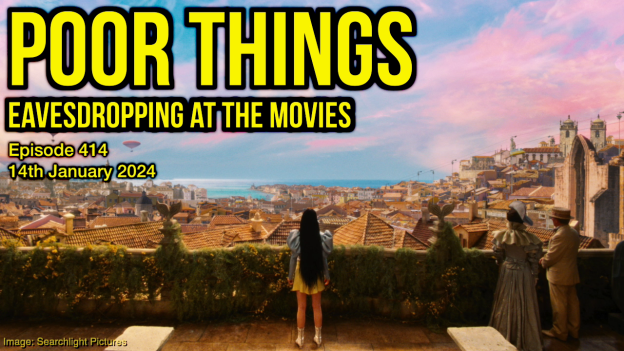
414 – Poor Things

Listen on the players above, Apple Podcasts, Audible, Google Podcasts, or Spotify.

Yorgos Lanthimos’ latest absurd comedy, Poor Things, creates a wonderful confluence of themes, all through the lens of Bella, a grown woman with a child’s brain, experiencing the world anew and detached from emotion. We discuss Bella’s attitude to the world she encounters, the men who try to control and cage her, Lanthimos’ idiosyncratic visual style and comedic sensibility, the examination of the nuances of sex, what Mike finds lacking in the brothel scenes, and more.

With José Arroyo of First Impressions and Michael Glass of Writing About Film.

413 – Priscilla

Listen on the players above, Apple Podcasts, Audible, Google Podcasts, or Spotify.

Hot on the heels of Baz Luhrmann’s Elvis, which cast the titular rock & roll icon as the victim of a life controlled by his manager, comes Priscilla, written and directed by Sofia Coppola, which tells a similar story of a life controlled – but here, Elvis is the culprit. in 1959, 14-year-old Priscilla Beaulieu meets 24-year-old Elvis during his military service in West Germany; by 1963, she’s moved in with him at Graceland, his famous Memphis estate. But the romantic life she desires is kept from her.

Priscilla is as rich an experience and as rewarding in conversation as we could have hoped for. Coppola intelligently and insightfully weaves together themes of unequal power dynamics, in which pleasure is withheld; the societally-defined roles of men and women and how they harm those who enforce them upon themselves; the significant age difference between Elvis and Priscilla, especially exacerbated by her youth; why and how beauty is constructed; and so much more. Its gaze is a female one, and a particular one at that. It understands the appeal of Elvis to Priscilla, the world in which she becomes involved and the men for whom it’s maintained, and the ways in which it deceives her, restricts her, and leaves her disillusioned. A marvellous, complex film.

With José Arroyo of First Impressions and Michael Glass of Writing About Film.

412 – The Goldfinger

Listen on the players above, Apple Podcasts, Audible, Google Podcasts, or Spotify.

In 2002, Tony Leung and Andy Lau starred in the Hong Kong classic Infernal Affairs, which Martin Scorsese remade in the US as The Departed; twenty years on, the inspiration flows in the opposite direction, Scorsese’s The Wolf of Wall Street a clear reference point for this fictionalised tale of real-life stock market manipulation, deeply embedded corruption, and the growth of a multi-billion-dollar company from meagre beginnings on the back of scams, confidence, and lies, with Leung starring as the charming, oleaginous company founder, and Lau as the anti-corruption official on his tail. We had terrific fun in The Goldfinger.

Which isn’t to say it’s a perfect film. We have our issues. The imagery could be more expressive – though director Felix Chong (another Infernal Affairs alumnus: he wrote the trilogy) clearly has an eye for visual impact, and there’s lots to be impressed by. We’d like to know why Lau’s corruption investigator believes that chasing Leung’s CEO is worth the disruption and danger to his family, beyond simply justice. We’d like any similar insight into what drives Leung, beyond simply greed. And if it is simply justice and greed, we’d like it to be better sold, bigger and brasher. We’d like the clash between the two to be more explosive. And the rather pat ending induces eye-rolling. But never mind all that. The Goldfinger is an entertaining and exciting tale of the rise and fall of a business empire that lived and died based on the fundamental corruption of the system and interests that built and supported it.

With José Arroyo of First Impressions and Michael Glass of Writing About Film.
411 – The Boy and the Heron

Listen on the players above, Apple Podcasts, Audible, Google Podcasts, or Spotify.

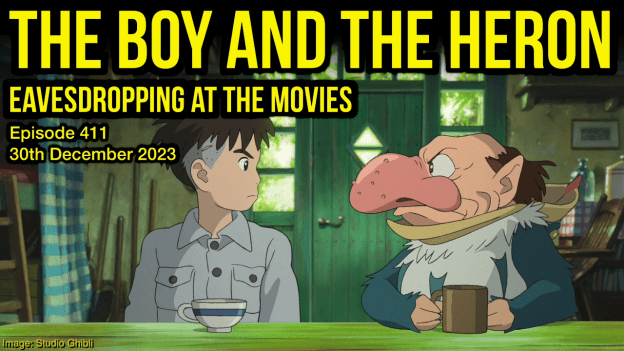
Hayao Miyazaki, the legendary Japanese animator and co-founder of Studio Ghibli, who has previously announced his retirement three times, tells us all that The Boy and the Heron (as it’s titled in most of the world; How Do You Live? in Japan) is really, honestly, for real this time, I’m super serious, his last film. His longtime producer, Toshio Suzuki, has already cast doubt on this new claim, but for now, here we have Miyazaki’s final film, which tells the story of Mahito, a young boy in wartime Japan, who loses his mother in a fire and is evacuated to his aunt’s countryside estate, whereupon he meets a talking grey heron that promises that his mother is alive.

José sees The Boy and the Heron as a masterpiece of cinema, a film that does things that other films have forgotten to do, a doorway to thinking about life, loss, and worlds within worlds. Mike… didn’t really get on with it, but he puts it down to taste and maybe mood – any objection he has can be equally levelled at things he loves. We easily agree that Miyazaki’s and Ghibli’s reputation for visual design and craft holds, with image upon image here that dazzles. As for what it all adds up to? Take José’s side. It’s better to like things than be bored by them.

With José Arroyo of First Impressions and Michael Glass of Writing About Film.
410 – Ferrari

Listen on the players above, Apple Podcasts, Audible, Google Podcasts, or Spotify.

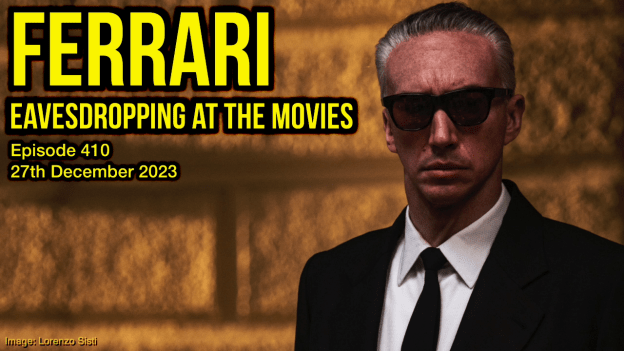
Adam Driver and Penélope Cruz star as lovers, business partners, and rivals, in a motorsport biopic that’s much more about the drama off the track than on it. In 1939, Italian racing driver, team owner, and entrepreneur Enzo Ferrari founded the car manufacturer that would become one of the best-known and most prestigious marques in history; Ferrari the film tells the story of events in 1957, with the company in financial difficulties and his wife, Laura, distanced from him as they grieve the recent loss of their son, Dino. She tolerates Enzo’s dalliances with mistresses, as long as he’s home before the maid arrives – but his second family is secret from her.

Mike sees an opportunity to right his wrongs from our podcast on Ford vs Ferrari, aka Le Mans ’66, in which, he declares, he overfocused on insignificant details, while José rightly and happily enjoyed the big personalities, charming and interesting central friendship, and entertaining, dramatic races… by suggesting they’ve switched seats. José finds the cultural specificity of the time and place in which Ferrari‘s set lacking, criticising missed or misunderstood nuances, and is let down by Driver’s blankness in key scenes opposite Cruz, whose brilliant performance subtly conveys Laura’s richly complex competing feelings. Details schmetails, counters Mike: here we have a big brooding drama about deep interpersonal clashes, grief, loss, power struggles and ambition, centred around an actor with fake grey hair and a faker Italian accent – what’s not to love?

As with Ford v Ferrari, we both enjoyed Ferrari. It’s just that one of us did so with a big, beaming, untroubled smile, and the other with a raised eyebrow that said “hmm”.

With José Arroyo of First Impressions and Michael Glass of Writing About Film.