Category Archives: Podcasts

458 – The Long Walk

Listen on the players above, Apple Podcasts, Audible, Spotify, or YouTube Music.

Cheap, simple, high-concept and reasonably graphic, The Long Walk is a throwback to the days of the B-movie. In its dystopian, totalitarian version of the USA, an annual event, the Long Walk, is designed to inspire a work ethic and national pride in the citizenry, and in so doing restore the country to that self-defined global number one status it craves; to make America great again. The televised competition sets fifty young men, one from each state, against each other in a test of endurance: they must walk for as long as they can, maintaining a speed of over 3mph at all times, with success rewarded with unimaginable riches and the fulfilment of a personal wish, and repeated failure to keep up punished with on-the-spot execution. There is one winner.

What promises to be quite dumb is not quite as dumb as Mike anticipates. The worldbuilding is fairly thin, and the premise of the competition an immediate hurdle for the audience to clear, but The Long Walk is able to develop thematically in surprising depth through the interactions and conversations between its competitors, who share their thoughts on the event, the personal histories that draw them to it, and their intentions if they win. With a number of reservations – we find its visual direction lacking and differ on how good the performances and screenplay are – it’s easy to recommend The Long Walk, which shows us an America in need of revolution, and asks its characters what it might take to achieve it.

With José Arroyo of First Impressions and Michael Glass of Writing About Film.
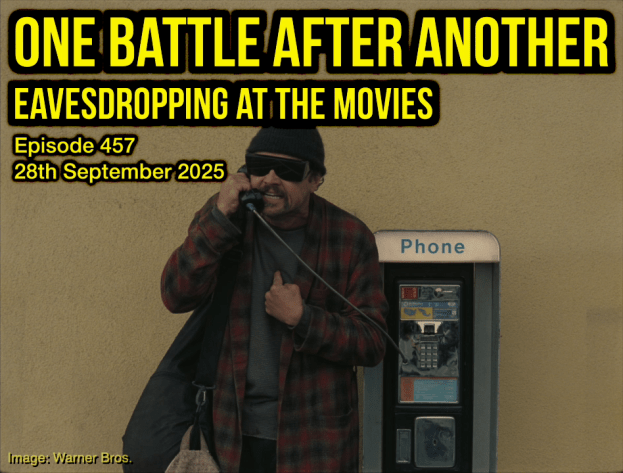
457 – One Battle After Another

Listen on the players above, Apple Podcasts, Audible, Spotify, or YouTube Music.

By far Paul Thomas Anderson’s most expensive film, with a budget some four or five times what he’s used to, and probably his most accessible, One Battle After Another entertains us enormously and effortlessly without sacrificing the complexity and nuance for which his work is known. Set in an alternate America oppressed by Christofascism, the alternate part is that there’s a very active militant revolutionary group, the French 75, setting bombs off and freeing detained minorities. Leonardo DiCaprio is part of it, and sixteen years after the conclusion of his group’s activities, their work has entered countercultural legend, but he’s become a drug-addicted, paranoid burnout, trying to raise a teenage daughter. When the powers that be come looking for them, they’re separated, all hell breaks loose, and he has to step up.

José finds One Battle After Another to be the film of the moment, the state of the nation film that Eddington could only dream of being, a powerful, invigorating expression of what ails America and what it means to resist. Mike is more cynical, seeing an element of mockery in the revolution that has no apparent intention to end and is carried out over generations. We love the easygoing style of filmmaking that Anderson seems to have grown into, comparing it to the rigid formality of his early work, and finding that he has a talent for action cinema that’s never quite come out before. We also discuss the film’s themes of youth and ageing, parenting, the Christian right and more.

One Battle After Another is an unmissable film, the kind that fifty years ago would have defined America’s national conversation. Cinema no longer holds that level of cultural cachet, sadly, but One Battle After Another is a powerful, energetic, and very funny reminder of what film can do at its best.

With José Arroyo of First Impressions and Michael Glass of Writing About Film.
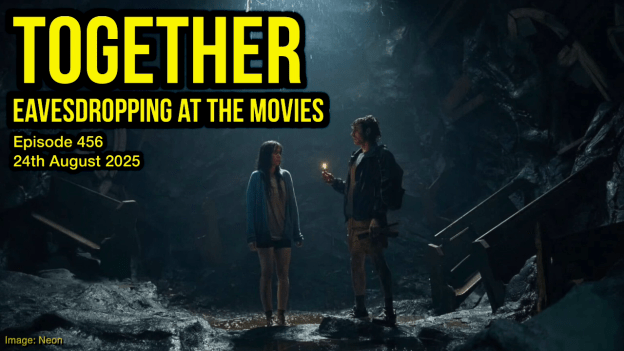
456 – Together

Listen on the players above, Apple Podcasts, Audible, Spotify, or YouTube Music.

Commitment is scary. It’s especially scary when you drink water from a cursed puddle that wants to make a hybrid of you and your partner. Together tells the story of a couple moving to a new home during a questionable period in their relationship: she has a new job and is responsible for the move away; he’s emotionally distant since the death of his parents and relies on her for transportation and financial security. They love each other, but will they last?

First-time director Michael Shanks demonstrates a good instinct for tone, effectively combining comedy and horror – that Alison Brie and Dave Franco (married in real life) are both experienced comic actors helps the film draw out the absurdity of the events it depicts. What quibbles we might have with details of its supernatural basis are easily ignored because its focus always remains on the central couple. It doesn’t matter that some specific detail might not be explained to our satisfaction: the question is always, how do the couple respond to their predicament? Together never loses sight of what’s most important, and that makes it one of the best horrors – maybe one of the best films full stop – that we’ve seen in a while.

With José Arroyo of First Impressions and Michael Glass of Writing About Film.

455 – Eddington

Listen on the players above, Apple Podcasts, Audible, Spotify, or YouTube Music.

Most film and TV has quietly agreed to pretend that the Covid pandemic never happened. Perhaps it’s too awkward to discuss it. Perhaps it’ll date your work. Writer-director Ari Aster doesn’t share these worries, telling a story about the days of lockdowns, mask mandates and conspiracy theories – days of particular hostility and division in the USA, in which individual freedom does constant battle with the greater good.

Eddington is an ambitious attempt at the state-of-the-nation film: a darkly comic thriller with wild tonal shifts, a mass of interwoven themes, uneven pacing, and an eventual climb out of reality into absurdity. José finds much to dislike, particularly its dismissive attitude towards the young people it depicts supporting the Black Lives Matter movement; Mike is surprised at how much he likes it, given how let down he felt by Hereditary. Eddington is certainly a mixed bag, but we’re glad to have seen it.

With José Arroyo of First Impressions and Michael Glass of Writing About Film.
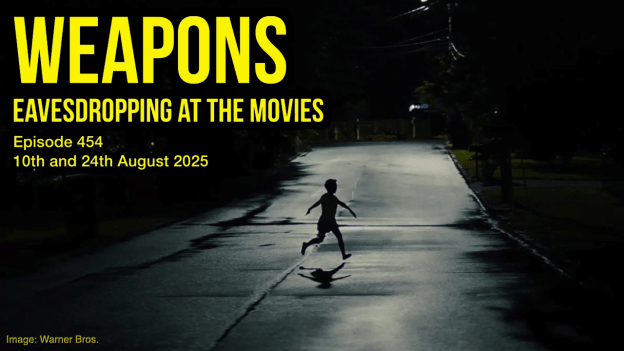
454 – Weapons

Listen on the players above, Apple Podcasts, Audible, Spotify, or YouTube Music.

One of the most hotly-anticipated horror films in recent memory, Weapons begins with seventeen third-grade children in a Pennsylvania town mysteriously waking up at 2:17am one Wednesday and running from their homes into the darkness. The shocking, unexplained disappearance and imagery of an empty classroom alone suggest an allegory of school shootings, and we ask what else can be read into the film, and discuss the depth with which it handles its themes. We have our issues with Weapons but enjoy it very much all the same, and find a lot to like. It’s probably just a little overpraised.

Two weeks later, with the film still on his mind, Mike opens up further discussion and proposes that maybe there’s more to it than he gave it credit for – or that you have to be American to properly get it.

With José Arroyo of First Impressions and Michael Glass of Writing About Film.

453 – The Shrouds

Listen on the players above, Apple Podcasts, Audible, Spotify, or YouTube Music.

A psychosexual thriller that’s neither psychosexual nor thrilling enough, The Shrouds is a disappointment. There’s great promise to businessman Vincent Cassel’s invention of a technologically advanced shroud that creates a 3D model of the decaying body it houses, when we’re shown the lust with which he observes his deceased wife’s corpse. The film is peppered with recurrent imagery of her disfigured body, and its importance to Cassel’s character is constantly reinforced, but the film is too talky, its imagery too bland, and its plot too convoluted to make the most of it. A shame.

With José Arroyo of First Impressions and Michael Glass of Writing About Film.

452 – The Ballad of Wallis Island

Listen on the players above, Apple Podcasts, Audible, Spotify, or YouTube Music.

Mike loves Tim Key. This much has been true for some time, and he’s thrilled to discover that the comic poet’s unique approach to wordplay and social interactions finds a natural place on the cinema screen, in the character of an eccentric lottery winner who lures his favourite folk duo, long since broken-up, to the lonely island on which he lives for a private gig. Tom Basden’s singer-songwriter finds the forced reunion an unwelcome intrusion from his past, and so begins a comedy about grief, loss, loneliness, and rice.

The plot is easily predicted, the visual nous close to absent, but it has a good heart and, in Key, an irresistably energetic, unusual central performance. It filled the Mockingbird with laughter and left us all feeling warm and cuddly and sad and happy. The Ballad of Wallis Island is a charming film, well worth watching.

With José Arroyo of First Impressions and Michael Glass of Writing About Film.
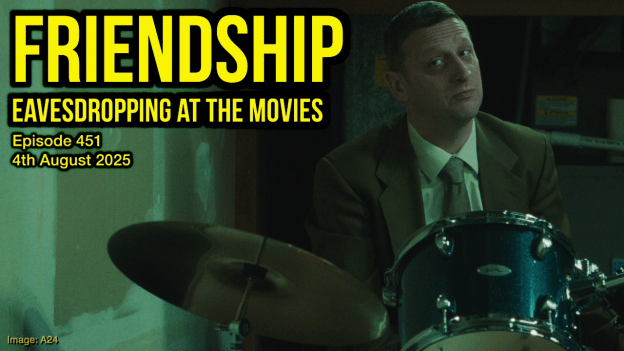
451 – Friendship

Listen on the players above, Apple Podcasts, Audible, Spotify, or YouTube Music.

We talk adult male friendships, stress and surreality in our discussion of Friendship, in which oddball everyman Tim Robinson finds himself enamoured with effortlessly cool new neighbour Paul Rudd, but lacks any of the social nous to naturally bond with him. The film gets huge laughs from meaningful subject matter, a far cry from our experience with The Naked Gun. Its tone is idiosyncratic and its observations on human nature ring true in their exaggerated way, and Robinson is a fascinating and hilarious presence on the cinema screen. Friendship won’t be for everyone, but we highly recommend it.

With José Arroyo of First Impressions and Michael Glass of Writing About Film.

450 – The Naked Gun (2025)

Listen on the players above, Apple Podcasts, Audible, Spotify, or YouTube Music.

The Naked Gun is rebooted with Liam Neeson in the part that was once Leslie Nielsen’s, and he shows just how hard comedy can be. We discuss everything the film gets wrong. If only they’d asked us for help.

With José Arroyo of First Impressions and Michael Glass of Writing About Film.
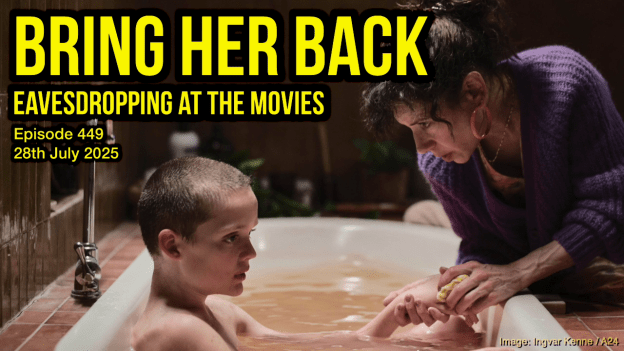
449 – Bring Her Back

Listen on the players above, Apple Podcasts, Audible, Spotify, or YouTube Music.

YouTubers-turned-directors Danny and Michael Philippou demonstrate a real eye for visual design and an ability to create imagery to truly disgusting effect in Bring Her Back, in which Sally Hawkins plays a foster parent whose daughter’s death leads her to search for answers in the occult. The filmmaker twins are 32 years old, which, perhaps unfairly, leads us to ascribe the film’s lack of depth and prioritisation of visual shock to their youth. Bring Her Back shows a certain immaturity, but great potential, and we’re interested to see if the pair’s storytelling and sensitivity to theme improves.

We also discuss child actors in horror, as the film drives Mike to question the ethics of using children as Jonah Wren Phillips is here, both in terms of the desired effect on the audience and the potential unintended effect on the child. Not all unease is good unease, and Bring Her Back makes us ask: what cost is too high for such entertainment?

With José Arroyo of First Impressions and Michael Glass of Writing About Film.