Category Archives: Podcasts

468 – Pillion

Listen on the players above, Apple Podcasts, Audible, Spotify, or YouTube Music.

Possibly the sweetest and lightest gay BDSM biker film ever made, Pillion opens up conversations on power dynamics, consent and boundaries, and made Mike cry. Everything about it is so assured, particularly Harry Melling’s understated protagonist, meek and new to BDSM; Alexander Skarsgård’s commanding, mysterious lover; and Harry Lighton’s direction, the control of tone he exhibits a remarkable achievement for a first feature. We explore the film’s themes, offer different interpretations of events, and ask what’s good and bad about the relationship depicted.

Pillion is a wonderful film, with, given the subject matter, a surprisingly funny and wholesome spirit. Highly recommended.

With José Arroyo of First Impressions and Michael Glass of Writing About Film.
467 – It Was Just an Accident

Listen on the players above, Apple Podcasts, Audible, Spotify, or YouTube Music.

One of Iran’s most celebrated filmmakers, Jafar Panahi, has spent the last quarter of a century in conflict with the Iranian government, which objects to his films’ criticisms of their actions and the wider social conditions in the country, and has both arrested him several times and banned him from making films for twenty years – which hasn’t stopped him. His latest, It Was Just an Accident, won the 2025 Palme d’Or, and tells the story of former political prisoners who capture a man they suspect was their torturer.

It’s a brilliant thriller which, despite the gravity and darkness of its subject matter, is energetic and entertaining. It effortlessly raises both moral and practical questions – What’s the right thing to do with their captive? Have they become the torturers? If they let him live, won’t he just come after them again? – without entering morality play territory, neither pretending to have the answers nor admonishing its characters for their choices and emotional responses. It’s a vivid expression of the lasting effect the actions of the Iranian regime have had on its people, for whom merely the suggestion that they might be able to exact revenge on their torturer causes instant emotional outbursts.

We discuss all this and more, including the depiction of a lawless culture in which you’re constantly expected to give bribes to get by; the filmmaking, in which no filming permits were provided and Panahi had to once again violate his filmmaking ban; the question of how ambiguous the end might be and what that means; and a comparison with American cinema in Trump’s America and the question of what might be happening under ICE, the immigration enforcement agency that’s expanded into a neo-paramilitary force over the last year.

It Was Just an Accident is a magnificent film. See it.

With José Arroyo of First Impressions and Michael Glass of Writing About Film.
466 – Nuremberg

Listen on the players above, Apple Podcasts, Audible, Spotify, or YouTube Music.

Russell Crowe shines in Nuremberg as Hermann Göring, who became the face of the Nazi Party following Hitler’s suicide and the end of the war, as he’s held in custody and probed by a psychiatrist as the titular trials approach. Indeed, while a mediocre film, its actors’ performances are a pleasure – with the exception of Rami Malek, whose psychiatrist is twitchy, busy, and a failure. A shame that he’s the protagonist, then.

We discuss the film’s structure and screenplay: José contends that Malek’s character is not just badly played but an irrelevance, and the drama would be much better served by focusing on Michael Shannon’s prosecutor; Mike criticises what he claims is a stupid person’s idea of clever writing.

And there’s more to think about: how Nuremberg compares to Bridge of Spies, which similarly depicted a novel trial that had obvious implications beyond the courtroom, and Judgment at Nuremberg, the other major dramatisation of the trials; the film’s tone, which is able to handle moments of humour but sometimes veers into the overly glib and kitsch; the present-day rise of fascism and the genocide in Gaza to which the film speaks; the use of real footage of Holocaust victims and the purpose to which it’s put; and whether we think that its critique of the Catholic Church for its support of the Nazis, and suggestion that dropping the atomic bomb on Japan was an unjustifiable atrocity, are surprising and bold things for a mainstream American film to do… or not particularly impressive, and shouldn’t people just know this stuff anyway?

With José Arroyo of First Impressions and Michael Glass of Writing About Film.

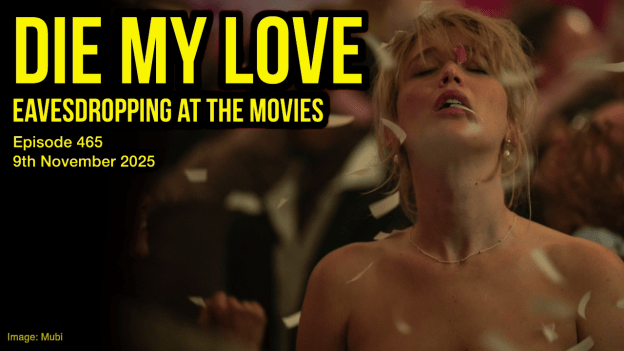
465 – Die My Love

Listen on the players above, Apple Podcasts, Audible, Spotify, or YouTube Music.

Jennifer Lawrence gives a career-best performance as a new mother struggling with depression and a rocky relationship in Die My Love, directed by Lynne Ramsay, whose remarkable instinct for tone and atmosphere shouldn’t be taken for granted. It’s a character study whose artistry is all in the filmmaking and performances, which bring out great richness of feeling in material that, on the page, might seem to lack complexity. One could suggest that those who’ve experienced similar struggles to the film’s characters hold the key to unlocking its depths, but that’s a temptation to avoid – one of the film’s achievements is the ease with which it gets you to feel what its characters are feeling. See it at the cinema, where you’ll be able to properly submit yourself to it.

With José Arroyo of First Impressions and Michael Glass of Writing About Film.

464 – Bugonia

Listen on the players above, Apple Podcasts, Audible, Spotify, or YouTube Music.

Yorgos Lanthimos’ fourth collaboration with Emma Stone yields a darkly comedic thriller about two conspiracy theorists who kidnap a CEO, determined to reveal the truth that she’s an alien from Andromeda. We’ve all at least considered it.

While funny and absurd, Bugonia is also tragic and misanthropic, and we’re unconvinced that its ending is either earned or fitting, despite Mike’s insistence that he’s seen it coming for weeks. We consider the film’s messaging, aesthetics, and tone; what its stars bring to it and how they differ; what the title might mean; and how a comparison with Alex Garland’s Ex Machina reveals the lacks in the storytelling here. We pick at Bugonia left, right and centre, but despite our complaints, it showed us a very entertaining time, and there’s a lot about it to recommend.

With José Arroyo of First Impressions and Michael Glass of Writing About Film.

463 – Frankenstein (2025)

Listen on the players above, Apple Podcasts, Audible, Spotify, or YouTube Music.

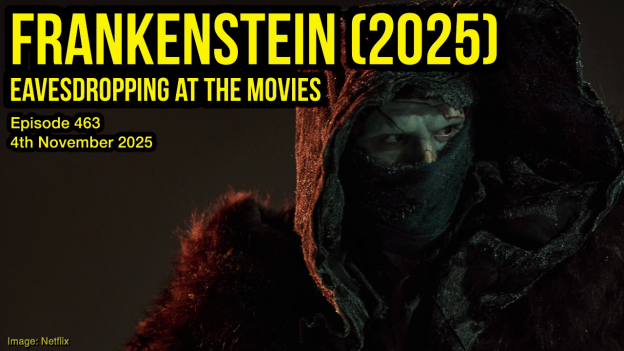
Another classic Gothic horror is remade for the modern age: first we saw Robert Eggers’ Nosferatu, and now Guillermo del Toro brings us his adaptation of Frankenstein. Like Nosferatu, Frankenstein is astonishing to look at, and, like Nosferatu, also written by its director, it probably would have benefitted from the attention of a professional screenwriter. Still, it’s a pleasure to spend time in the word del Toro envisions, and we talk wide angle lenses, the range of performances – Oscar Isaac’s busy, Jacob Elordi’s brooding, Mia Goth’s underwhelming – the difficulty of understanding dialogue in screen two at the Mockingbird, and what this Frankenstein thematically shares with One Battle After Another.

With José Arroyo of First Impressions and Michael Glass of Writing About Film.
462 – Tron: Ares

Listen on the players above, Apple Podcasts, Audible, Spotify, or YouTube Music.

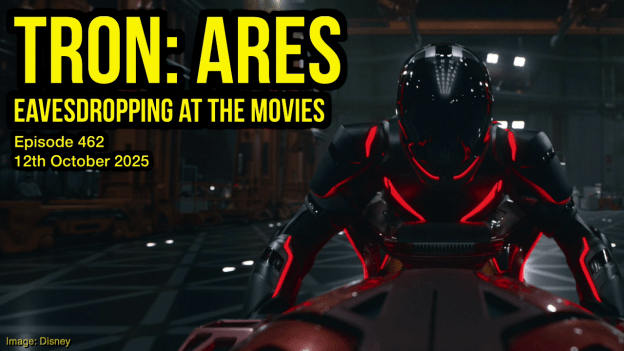
Far from an outstanding film, but amazing to look at and too much fun not to recommend, we had a great time in Tron: Ares, which reverses the reality-computer interface that brought humans into the digital world in the previous two films; it’s now the virtual that becomes real. An evil company searches for the code that will give its 3D printed computer assets longevity in the real world – so far, they crumble into dust after about twenty minutes – but the AI tasked with doing so goes rogue, hoping to use the code to bring itself to life. It’s Pinocchio and Frankenstein with neon-oozing motorbikes, and as entertaining as that sounds. (We think that sounds entertaining.)

With José Arroyo of First Impressions and Michael Glass of Writing About Film.

461 – One Battle After Another – Second Screening

Listen on the players above, Apple Podcasts, Audible, Spotify, or YouTube Music.

Listen to our first podcast on One Battle After Another here.

We’re joined by our resident Paul Thomas Anderson expert (and Mike’s brother), Stephen Glass, to whom we’ve previously spoken about Phantom Thread and Licorice Pizza, for another discussion of One Battle After Another. Stephen’s seen it in both VistaVision and IMAX 70mm, and can offer a sense of the experience Mike and José missed seeing it in IMAX Digital, and so begins a wide-ranging conversation about the film’s aesthetics, tone, politics, influences and more.

With José Arroyo of First Impressions and Michael Glass of Writing About Film.
460 – The Smashing Machine

Listen on the players above, Apple Podcasts, Audible, Spotify, or YouTube Music.

Mike isn’t impressed with The Rock’s attempt to take on a dramatic role in an intimate biopic after decades of popcorn blockbusters, seeing it as Oscar bait. José doesn’t share his cynicism and likes the lead performance. We discuss what The Smashing Machine depicts – disagreeing, in particular, about whether the protagonist shares any blame for the issues in his relationship – as well as whether its look and storytelling are problems, and just how shoddy things are getting at Cineworld. Yet we keep going back.

With José Arroyo of First Impressions and Michael Glass of Writing About Film.
459 – A Big Bold Beautiful Journey

Listen on the players above, Apple Podcasts, Audible, Spotify, or YouTube Music.

A Big Bold Beautiful Journey, directed by former video essayist Kogonada, is beautiful to look at and very likeable, but derivative and ultimately unsatisfying. We discuss its lighting, its attitude towards people’s histories and the memories that live with them, and why a rubbish script Mike once wrote makes him particularly keen to sneer at it.

With José Arroyo of First Impressions and Michael Glass of Writing About Film.