An ambitious, large-scale Netflix production, The Old Guard throws special ops, behind-enemy-lines-style action together with intriguing superhero-style mythology. Charlize Theron leads a team of immortal warriors, ranging from hundreds to thousands of years old, who find themselves on the run from corporate and military-industrial pursuers.
José is captured by the film from the beginning, his love for Theron’s action stardom and the film’s mysterious setup pulling him in; Mike takes an age to warm up to it, his inherent suspicion of all things Netflix keeping him wary. But when the story develops its romantic side, he softens, and both agree on what the film does best: the defiant declaration of love from one man to another, surrounded by armour-plated, heavily armed police. The Old Guard approaches representation of different sexualities and ethnicities in heartfelt, open ways, and the prospect of sequels that develop that further – perhaps even a universe – is promising.
Ultimately, José loves The Old Guard much, much more than Mike, but it wins us both over.
Could we have found a Christopher Nolan film that José actually enjoys? We explore the brilliantly imagined and executed Inception, a heist movie set inside the human mind, talking up the intelligence and creativity with which the central concept is used, the elegant and effective intercutting and structure, and the noirish, expressive romance that underpins the entire affair.
We’ve had some disappointments with Interstellar and the DarkKnighttrilogy, but Inception was just the antidote. Boy, are we fired up for Tenet now.
Making spoof Inception trailers was all the rage around the time of its release, and here are the two Mike made.
We finish off Christopher Nolan’s Batman trilogy with The Dark Knight Rises, the most entertaining and enjoyable of the three films. In a Gotham free of crime thanks to the draconian Dent Act, passed in the wake of Harvey Dent’s murder at, so the story goes, the hands of Batman, who hasn’t been seen since, the intriguing, intimidating, revolutionary figure of Bane arrives to terrorise and occupy the city. A recluse since the events of The Dark Knight, the threat of Bane gets Bruce Wayne back in his cowl, but he finds he’s met his match.
We again question the film’s politics, Mike arguing that its fascism isn’t so much particular to this series as a core component of Batman in principle, and that maybe the most a Batman story can do is ignore it, rather than fix it. Its aesthetics come back into focus too, in its cinematic style and militaristic sensibility, José taking issue with both, though he loves the opening set piece. He finds a new appreciation for Michael Caine, and we take pleasure in the new additions to the cast, particularly Tom Hardy and Anne Hathaway, and we leave the series in agreement that no matter our problems, it ended on a fun note.
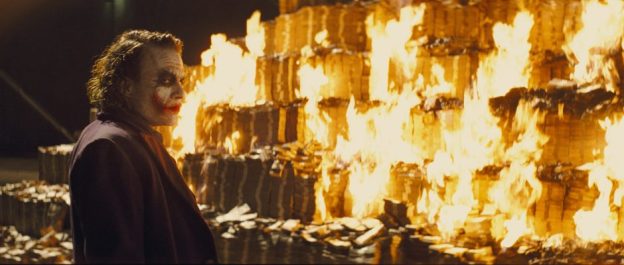
Having established a muted tone in Batman Begins, Christopher Nolan’s Batman series receives a welcome injection of flair in Heath Ledger’s Joker, the villain and main attraction of 2008’s The Dark Knight. Ledger’s Joker captured imaginations and helped the film to a billion dollar box office gross, back when hitting that milestone was rare. José, as with Batman Begins, never got The Dark Knight, while Mike was so hyped for it that he saw it twice in IMAX before its official release. We discuss what holds up today and what doesn’t, what the appeal is, the 70mm IMAX cinematography, how and why the film became a cultural meme, and what ideologically drives it.
Planet Earth is dying, dust storms are wiping out crops, and all-American single dad, former NASA pilot and corn farmer Matthew McConaughey is our last hope for survival. A “ghost” appears in his daughter’s bedroom, appearing to communicate by affecting gravity, and decoding the messages leads our hero to discover the last remnants of NASA, their observations of a wormhole near Saturn, and their journeys through it to planets that might be able to sustain human life. Eventually convinced of the plan’s value and necessity, McConaughey agrees to lead a mission through the wormhole himself, leaving his family behind, but hoping to rescue them in the long term.
Mike was moved and surprised by Interstellar upon its release in 2014, but on this second viewing moves significantly towards José’s unimpressed response, wondering whether it was simply the novelty of seeing new things to which he responded so positively. He compliments the film’s scientific literacy, but complains that its dedication to incorporating scientific principles and registers can impede what should be dramatic developments, making them dry and clunky; José, who has no ear for science, finds that it’s an irrelevance, unable to tell what might be drawn from reality and what isn’t, and feeling that the film doesn’t dramatise it well.
Everything is rendered through the central family and in particular the father-daughter relationship, strained because of the father’s mission, and consistently the film’s most important consideration, a little simple considering the global nature of Earth’s problems and the countless other families the mission is intended to help. The mission’s revelations and problems affect the entire world, and are discussed as such in dialogue, but we feel only the impact on this family – Interstellar speaks of societal problems but doesn’t show or dramatise them. Mike argues, though, that that central connection is handled well, the most effective shot, in a film full of startling visuals, one of a father’s face looking at his children.
We think about the action, and what it lacks. There are plenty of high-concept set pieces, but all seem to miss something in the execution. And we discuss the black hole scene, the design of that space and what it means, and how, while Mike was totally swept up in it upon first viewing, it quickly falls apart.
We’re glad we’ve seen Interstellar again, and at the IMAX Digital, the best available screening outside of true IMAX – because our response can’t be blamed on watching it on a laptop. We saw it as it should be seen, and emerged disappointed. Oh well.
Cineworld’s reopening brings socially distanced screenings of past hits while the studios figure out their strategies for new releases, and with the highly anticipated and imminent release of Christopher Nolan’s new sci-fi, Tenet, his previous blockbusters are once again showing. José chooses Batman Begins, hoping to understand what he didn’t get when he first saw it in 2005, and why it matters.
To Mike’s generation and demographic, Batman Begins is, if not a great film, an important one, as its muted aesthetic and attempt to render Batman and Gotham as plausible entities, capable of existing in the real world, signalled a significant difference from the outlandishness of both previous and contemporary comic book adaptations, and its tone conveyed a seriousness of purpose – how honestly or successfully is up for debate – that contributed to the idea that superhero films could begin to be taken seriously and even considered as Oscar contenders. And, although his previous three films had all been successful, Batman Begins was the first blockbuster of Nolan’s career, and the financial success and cultural impact of his work would only increase, making him a dominant figure in cinema for people like Mike.
But Nolan’s Batman trilogy has always left José feeling lost – something that might be true of Nolan’s work overall – and he’s keen to work out what he might be missing, whether it’s more than just a generational thing, or whether, indeed, it’s the children who are wrong.
We think through how Nolan reimagines Batman, and how differently Batman Begins feels now that it’s fifteen years old. Mike suggests that the benevolent billionaire figure of Thomas Wayne, Batman’s dad, is no longer believable, if indeed it ever should have been, and José turns a peeve about Nolan’s almost entirely European casting into a working theory about the Britishness of his film, and what that means for its fidelity to the themes and tone of the comic books on which it’s based.
We’ll be following this up with discussions of the two successive DarkKnight films, as well as Interstellar and Inception, in this impromptu Christopher Nolan season. It’s all thanks to finally being back at the cinema, where, as José loudly shouts in the face of everyone who think their big telly is great, all films are best seen – especially Christopher Nolan’s.
Our exploration of William Friedkin ends almost where it began, with his second collaboration with Tracy Letts, who, following the adaptation of his second play, Bug, adapts for the screen his first, Killer Joe. A key film in Matthew McConaughey’s career, one of the first in what would become known as the McConaissance, Killer Joe sees his seductive, charming romcom persona repurposed to threatening, chilling effect in the ugly world of trailer parks and contract killing.
We discuss THAT scene with the chicken leg, and compare and contrast it to THAT scene with the crucifix in The Exorcist, asking what might be outrageous about one but not the other. We ask what we’re missing in Letts’ screenplay that others see, and José argues that Friedkin has throughout his career been drawn to second-rate source material – material that here is unquestionably elevated by the cast, who are almost all excellent and believable, in particular Gina Gershon, of whom demanding things are asked, and Juno Temple, who carries with her an otherworldliness that lightens what is a very dark part in a very dark story.
And we take the opportunity to think over the set of Friedkin films that we’ve now seen, including his biggest hits, and consider what we’ve learned, what his achievements and strengths are, where he fails or what he lacks, and where he stands amongst his contemporaries and peers.
José has previously written twice on Killer Joe, once on his blog, and once on The Conversation.
No exploration of William Friedkin would be complete without The Exorcist, 1973’s iconic horror about a little girl possessed by a demon, and so watch it we do.
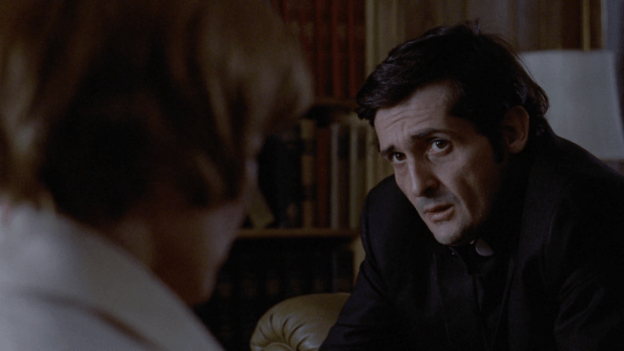
We watch the theatrical cut, which Mike’s excited to see, since the only one he’s seen before is “The Version You’ve Never Seen”, the extended cut released in 2000, and he finds this version superior, with better pacing and fewer distractions. José has always had a significant problem with the crucifix scene, and we go into why, and he argues that the film exhibits a desire to shock above all else that is typical of Friedkin. Mike argues for the sympathy we feel for Father Karras and his centrality – Max von Sydow’s Father Merrin is in theory the eponymous exorcist, but is that actually the case? And we think over much more besides, including the thrill of the special effects, the disparity between how Mike Oldfield’s Tubular Bells is used and its subsequent iconic synonimity with the film, whether the film should be clearer about the boundaries of its demon’s abilities, and ultimately, the fact that it’s so famous – or is that infamous? – that even Mike’s mum still references the projectile vomit bit.
José’s video note on the connection between The Exorcist and No News From God:
As likeable as it is incoherent, Jade oozes style and steaminess. David Caruso’s assistant district attorney, searching for the killer of a businessman, finds himself delving into a world of kink, prostitution and power, in which Linda Fiorentino, his former lover, is embroiled.
William Friedkin’s attraction to the taboo is at home in the world of the erotic thriller, but as enjoyable as Jade is, it’s a film you watch with one eye on its substantial problems. It’s a film in which everything is done for effect, and damn the consequences – especially the final twist, which turns the film’s sexual liberation and power dynamics on their head, for no good reason. Still, it’s a film we were both happy to watch twice, and as superficial as it may be, that surface is highly polished and glossy.
To Live and Die in L.A., William Friedkin’s 1985 neo-noir, is kinky, colourful, offbeat and as much a Los Angeles film as The French Connection is a New York one. A young and androgynous Willem Dafoe plays a notorious counterfeiter pursued by two Secret Service agents, one by the book, the other corrupted. We discuss the film’s style and tone, its subject matter and setting in L.A.’s liminal, casually confrontational criminal underworld, its sensuous cinematography, and how it reflects and contrasts with The French Connection, particularly in the context of the films’ morally cloudy protagonists.
José has a soft spot for To Live and Diein L.A. despite acknowledging several problematic facets to it; Mike can’t say he loves it, finding little satisfying to bite on other than the extraordinarily expressive imagery and Dafoe’s captivating presence. Still, it’s a bold, evocative work of very, very Eighties noir, and deviant enough to keep you on your toes.






 Eavesdropping at the Movies